Hridey Kapoor
 https://orcid.org/0009-0007-2964-1839



Mechanosensory stimuli, rather than ambient light, shapes freshwater hatchetfish aerial escapes
Integrative and Comparative Biology 66 See this paper
Abstract
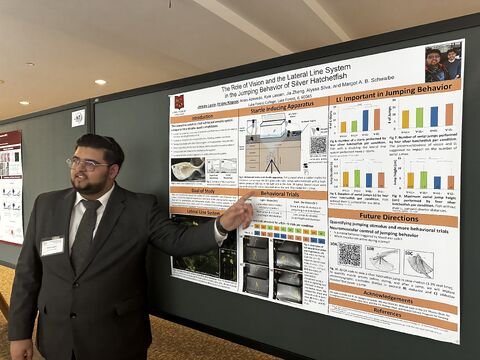
Many fishes can propel themselves out of water, but few species exhibit the intentional, repeated jumping behavior as seen in freshwater hatchetfishes (Ostariophysi: Characiformes: Gasteropelecidae). Freshwater hatchetfishes have a unique body plan characterized by a deep keel and enlarged pectoral fins, which are specialized for ballistic jumping behavior to avoid predation. Rapid underwater and aerial escape behaviors are likely mediated by multiple sensory modalities, including visual and mechanosensory systems. We used fluorescent staining to visualize the neuromasts of the lateral line system and high-speed videography to quantify aerial escape responses induced by a custom vibrational apparatus in two species, Gasteropelecus maculatus and Thoracocharax stellatus. Behavioral experiments were conducted using fish pairs (one species per pair) across a 2 × 2 factorial design: light vs. dark (infrared) and intact vs. chemically ablated (neomycin-treated) lateral line systems. Behavioral outcomes were categorized as no response, underwater C-start, or aerial escape, followed by kinematic analyses of the jumps. Morphological analysis revealed an unusual lateral line system characterized by modified cranial and trunk canals alongside a massive proliferation of superficial neuromasts, particularly on the dorsal surface of the head and on the ventral keel. Behavioral results demonstrated that fish with ablated lateral line systems performed significantly fewer escape maneuvers than intact individuals, regardless of light condition. Furthermore, lateral line-ablated fish exhibited significantly shorter jump path lengths, reduced jump durations, and lower maximum vertical displacements. While fish jumped at remarkable speeds (mean: 56 ± 14 BL/s), maximum jump velocity and most body orientations (pitch and yaw) did not vary significantly across experimental conditions. Our findings demonstrate that the mechanosensory lateral line system is an important sensory modality contributing to escape performance in freshwater hatchetfishes, particularly in response to vibrational stimuli, while the relative roles of vision and hearing warrant further study. We conclude that both the highly derived body shape and the lateral line system of freshwater hatchetfishes are evolutionarily tuned to enhance survival through rapid detection of mechanosensory stimuli and execution of aerial escapes.